The Edge of Intelligence
Where in your work does genuine intelligence happen that no system could replicate?

🧭 Welcome to Weekly Wandering, a short digest where I share a few signals, ideas, and articles at the intersection of innovation, change, and technology. Each week, I curate a handful of perspectives to explore one question and help make sense of the forces reshaping organizations and the work of those trying to build the future more thoughtfully.
A Prompt for the Week 💭
Where in your work does genuine intelligence happen that no system could replicate?
From org charts to LLMs to intergenerational foresight, this week's reads share a common concern. On the one hand, we're getting better at building efficient systems. On the other hand, we are getting worse at questioning what those systems are actually for. The edge of your work, where you make contact with messy reality, turns out to be where most of the value lives. The more we build systems to route intelligence, the more we risk losing the thing those systems were meant to serve.
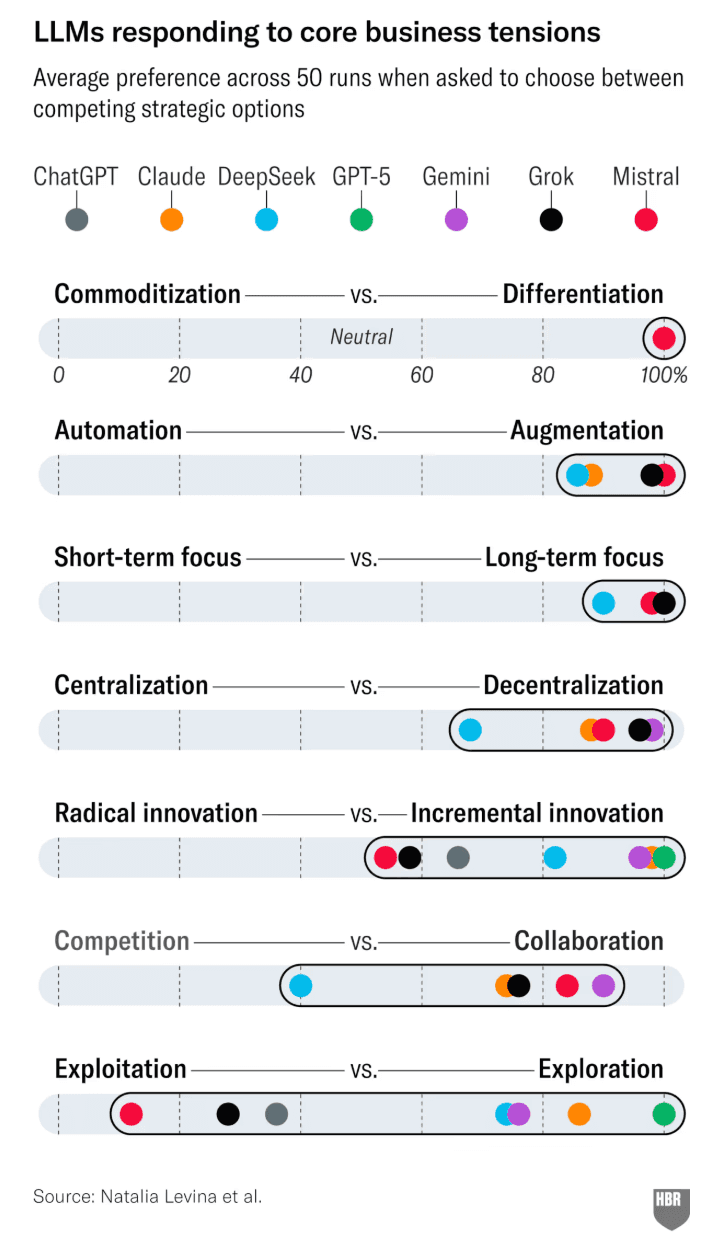
📌 Researchers Asked LLMs for Strategic Advice. They Got “Trendslop” in Return. - Harvard Business Review
Leaders are increasingly outsourcing their strategic thinking to LLMs. However, compared with your colleague sitting next to you at the office, who might offer you genuine, critical feedback, a new HBR study by Angelo Romasanta, Llewellyn D W Thomas , and Natalia Levina suggests those models tend to be flattering to them with fashionable ideas rather than sound ones. The term the researchers coined, "trendslop," names the pattern: AI that optimizes for coherence and consensus over genuine strategic insight. The authors suggest a few practices to safeguard your strategic thinking, such as using LLMs to expand options, not making choices, or not relying on context alone.
Like the kid who didn’t actually do the reading (despite doing all the reading), LLMs are not analyzing your specific business—they’re just offering up a polished version of popular answers that sound good. They are the person in the room who can effectively articulate the business buzzwords they hear from TED Talks and conference seminars, but who has never actually analyzed how these might work in the messy realities of the specific business and market situation.
📌 AI Evolution in Human + AI Organizations
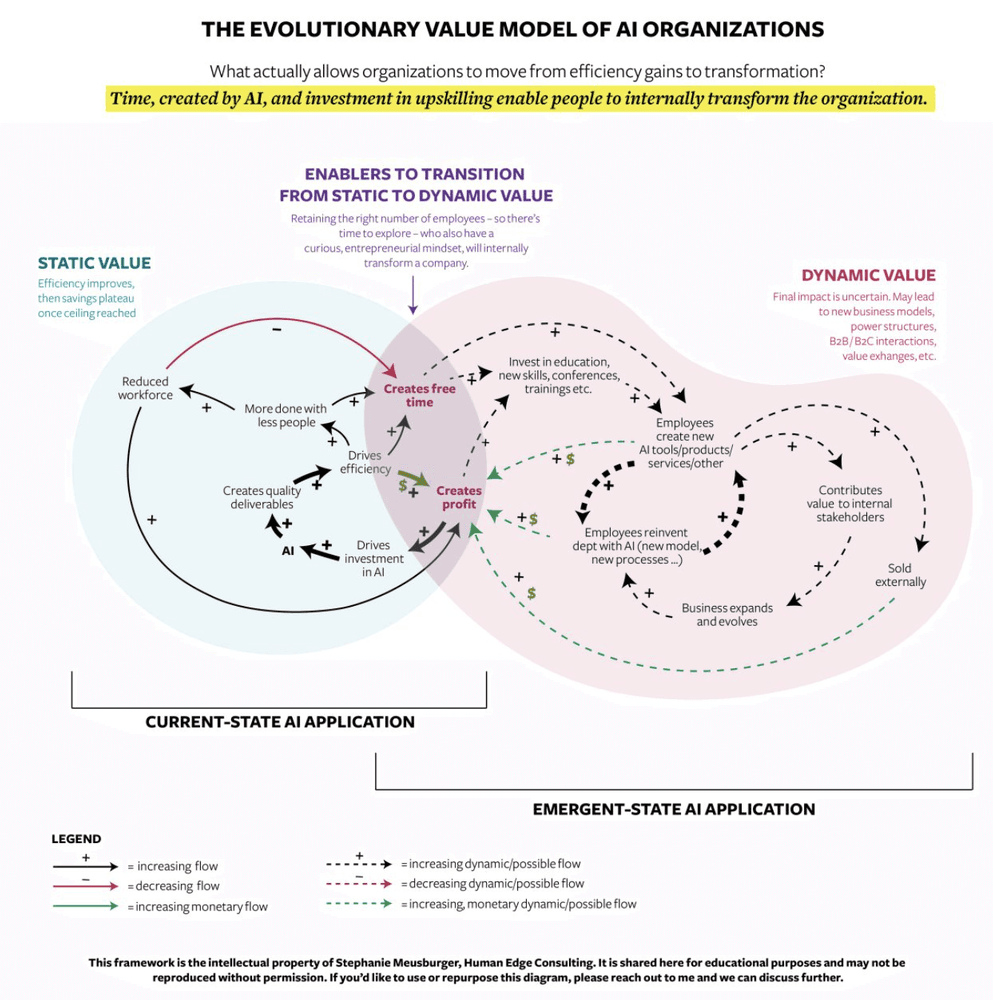
Drawing on the philosophy of Robert M. Pirsig in "Zen and the Art of Motorcycle Maintenance", this new framework imagined by Stephanie Meusburger maps how AI moves through organizations. AI in organizations tends to follow two distinct value loops: one that optimizes existing processes, and one that unlocks entirely new possibilities. It highlights one of the core tensions at the heart of AI transformation: Companies that cut headcount to capture efficiency gains may be quietly dismantling the very mechanism that drives real transformation.
📌 From Hierarchy to Intelligence - Sequoia Capital
From the Roman contubernium to today's global enterprise, organizational hierarchy has served as an information-routing protocol for two thousand years. Through a brief walkthrough of the history of organizational structures, Jack Dorsey and Sequoia's Roelof Botha explain that this whole paradigm was built around one human limitation: a leader can only effectively manage three to eight people. However, they argue that AI is dissolving that constraint entirely. Now that AI can maintain a continuously updated model of an entire business, the case for middle management collapses — and a new org structure where the role of humans is to operate at the "edge".
In a conventional company, the intelligence is spread throughout the people and the hierarchy routes it. In this model, the intelligence lives in the system. The people are on the edge. The edge is where the action is. The edge is where the intelligence makes contact with reality. People reach into places the model can’t go yet. They sense things the model can’t perceive: intuition, opinionated direction, cultural context, trust dynamics, the feeling in a room.
📌 Scaling Cynefin - The Cynefin Company
Dave Snowden's latest provocation on scaling cuts against the grain of most organizational thinking: you can't scale a complex system by copying what worked. The author of the Cynefin model, the infamous decision-making and sense-making model for complexity, argues that the right approach is decomposition — breaking things down to the optimal level of granularity — and then letting recombination happen in context. Wisdom, he points out, doesn't scale through aggregation; it scales through connection.
A complex system scales by decomposition and recombination, not by imitation or repetition. Think DNA, from four chemicals, the whole of organic life has emerged. What propagates in complex systems is not practices but the capacity to recombine in different ways across contexts. Scaffolding is helpful, but its purpose is to enable a sustainable structure to emerge, not to be that structure. The question is not “how do we get this thing into more places?” but “what were the primitive moves that made this work here, and which of those can find new expression in different conditions?”
📌 Intergenerational Foresight: An Approach for Long-Term Responsibility in Governance - World Economic Forum
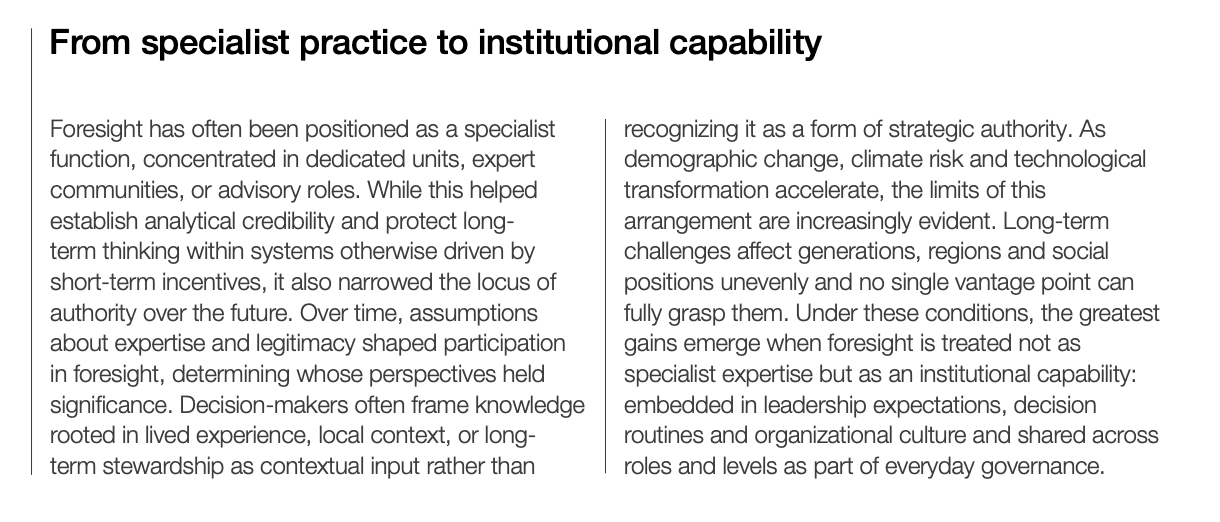
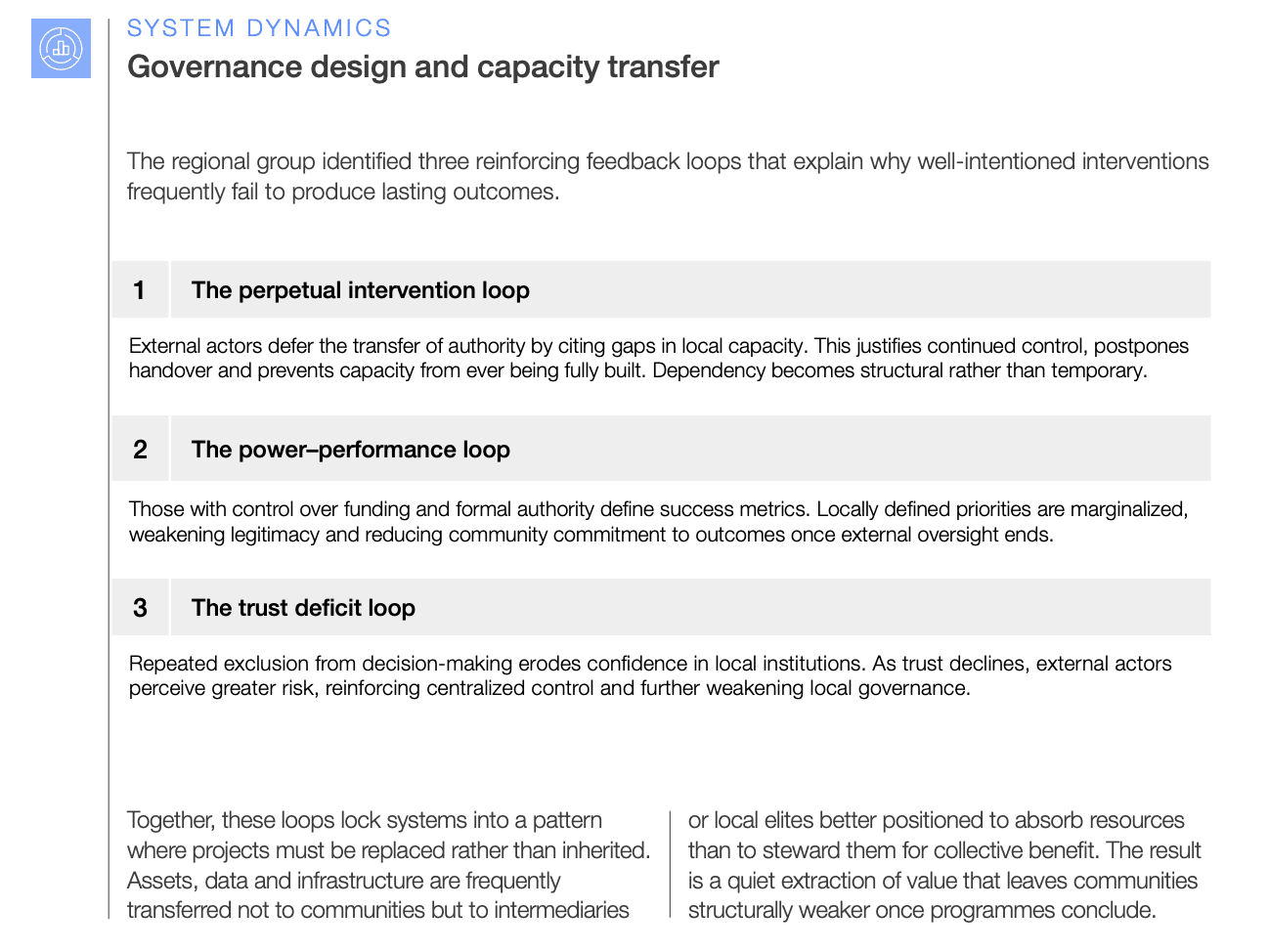
A study of 400 senior executives from Forbes Global 2000 companies reveals a troubling pattern: 64% of major firms plan no further than five years ahead, while only 1.2% extend their strategic view beyond a decade. World Economic Forum. This recent WEF Intergenerational Foresight is investigating some of the sources of failure and makes the case for more inclusive, wider participation in foresight initiatives. With strategic foresight dominated by senior leaders in Western institutions, those who will actually live with long-term decisions remain excluded. The fix isn't better models; it's deliberately distributing authority across generations, cultures, and regions inside the foresight process itself.
Excerpt 1 from report
Excerpt 2 from report
Thanks for reading. See you next week for another wandering through ideas shaping change, innovation, and technology.