How Change Actually Happens?
Think of a belief or behavior you changed recently. What actually drove it? An argument, or the people around you?

🧭 Welcome to Weekly Wandering, a short digest where I share a few signals, ideas, and articles at the intersection of innovation, change, and technology. Each week, I curate a handful of perspectives to explore one question and help make sense of the forces reshaping organizations and the work of those trying to build the future more thoughtfully.
A Prompt for the Week 💭
Think of a belief or behavior you changed recently. What actually drove it? An argument, or the people around you?
This week's articles converge on the shared provocation that the tools we rely on to drive change — education, expert reports, persuasion — tend to be weaker than we think. What actually moves people and organizations is the invisible architecture around them: networks, cultures, infrastructures, and the conditions under which real dialogue can unfold.
📌 Why trying to educate people to change doesn't work - Fast Company
A sharp challenge to the assumption that informing people leads to changing them. Drawing on social science, the piece from Greg Satell argues that beliefs and behaviors are shaped less by what people are told than by the norms and actions of those around them — and that durable change requires redesigning networks and cultures, not crafting better messages.
"The truth is that the best indicator of what people do and think is what the people around them do and think. Instead of trying to shape opinions, we need to shape networks. That's why we need to focus our efforts on working to craft cultures rather than wordsmithing slogans."
📌 Building a human resilience infrastructure for the age of AI - Elon University
A quite extensive but very comprehensive and insightful report led by Elon University on the infrastructure of resilience needed for the acceleration age to counterbalance the human and systemic challenges posed by widespread AI adoption. Pointing at the issues that we are starting to see emerging, 386 experts laid out in this 300-page report a blueprint for restructuring our organizations for resilience, but also broader themes such as how to rewire human behavior for the human age, how to seek human connection and calm, and how to cultivate human agency.
Among the number of major issues to be addressed to enhance human resilience, they cite, for example:
Superstupidity (not superintelligence) is the real threat: “The existential danger to people may not come from AI becoming too intelligent, but from humans becoming dangerously reliant on systems they do not understand – the condition of superstupidity. The question is not how much AIs will augment decision-making, but whether humans will remain involved in it at all. The film ‘Idiocracy’ is prophetic.” – Roger Spitz
Analog communities of resistance will form around analog ‘dumb homes’: “Pockets born out of social need, perhaps most largely driven by women – who have traditionally prioritized relational roles in society – will form a resistance. Hence, intentional ‘analog communities’ will form in which the ‘smart home’ idea is inverted into ‘dumb homes’ and mostly digital-free lifestyles.” – Greg Sherwin
AI psychosis and other forms of mental illness will arise. This contributes to the erosion of reality that has already been set in motion by other AI forces. – Stephen Adelson
📌 The enterprise AI playbook: lessons from 51 successful deployments - Stanford Digital Economy Lab
A thorough study from Stanford Digital Economy Lab published earlier this year that maps the practices of organizations that are not just experimenting with AI but successfully deploying it at scale. Across four selection criteria (operational stability, sustained business adoption, quantified value creation, and scalability & replicability), they present 11 findings, supported by concrete case studies, that separate a successful pilot from a failed one.
"Same technology, same use cases, vastly different outcomes. The difference was never the AI model. It was always the organization. Its readiness, its processes, its leadership, its willingness to change and fail."
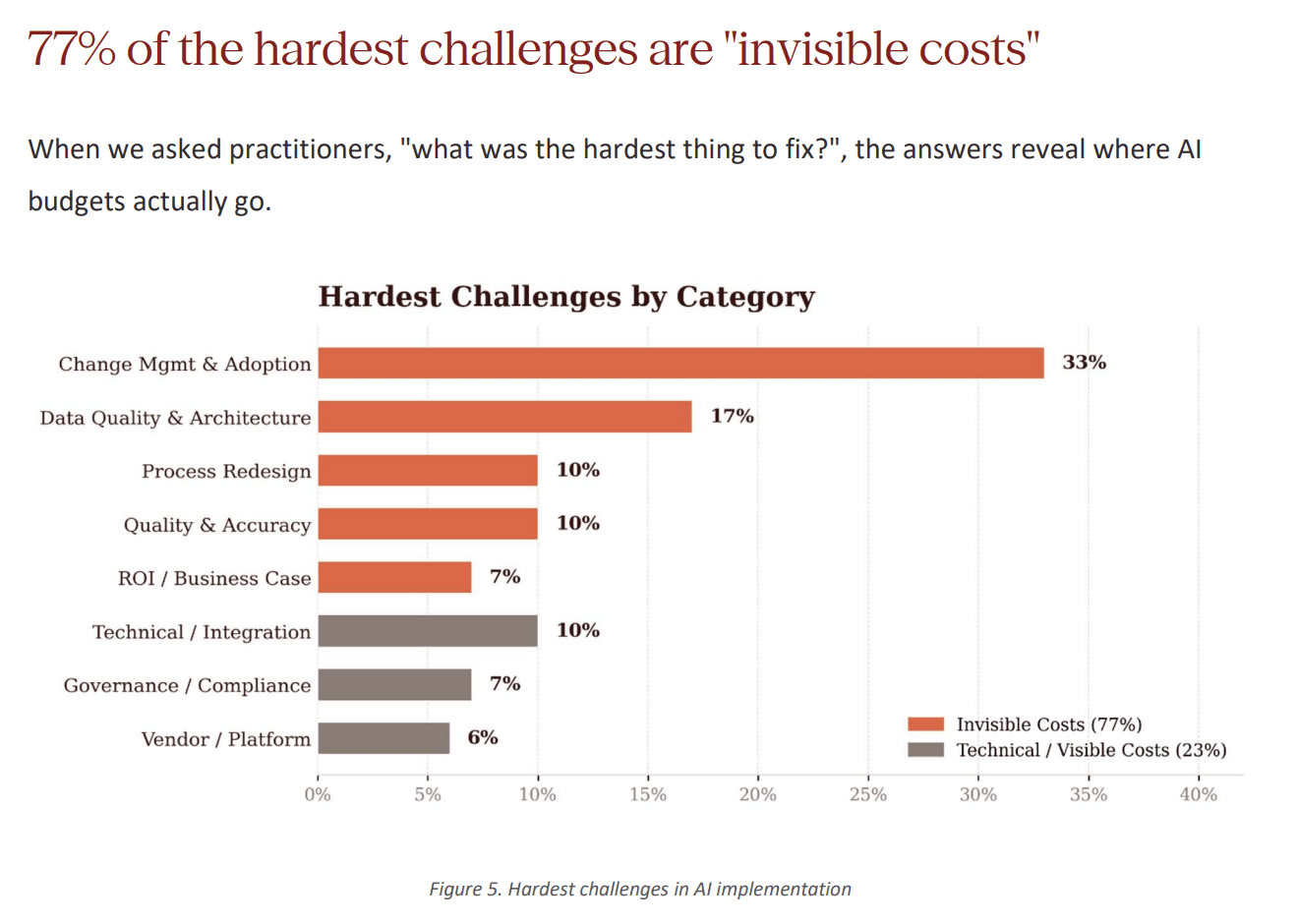
Excerpt from report, The AI enterprise AI Playbook
📌 Making sense of slow AI - Metalabel x AIxDesign x Internet Teapot
What if AI didn't run on Silicon Valley logic? Created with the zine aesthetic at the AIxDESIGN Festival, the Slow AI project is a thought experiment recently released on Metalabel piecing together 40 pages of eclectic stories on Small AI, Esoteric AI, and Ancestral AI. Inspired by countermovements such as slow fashion and slow food, it seeks to unpack and reimagine alternative narratives about AI, moving beyond dominant Silicon Valley ideologies.
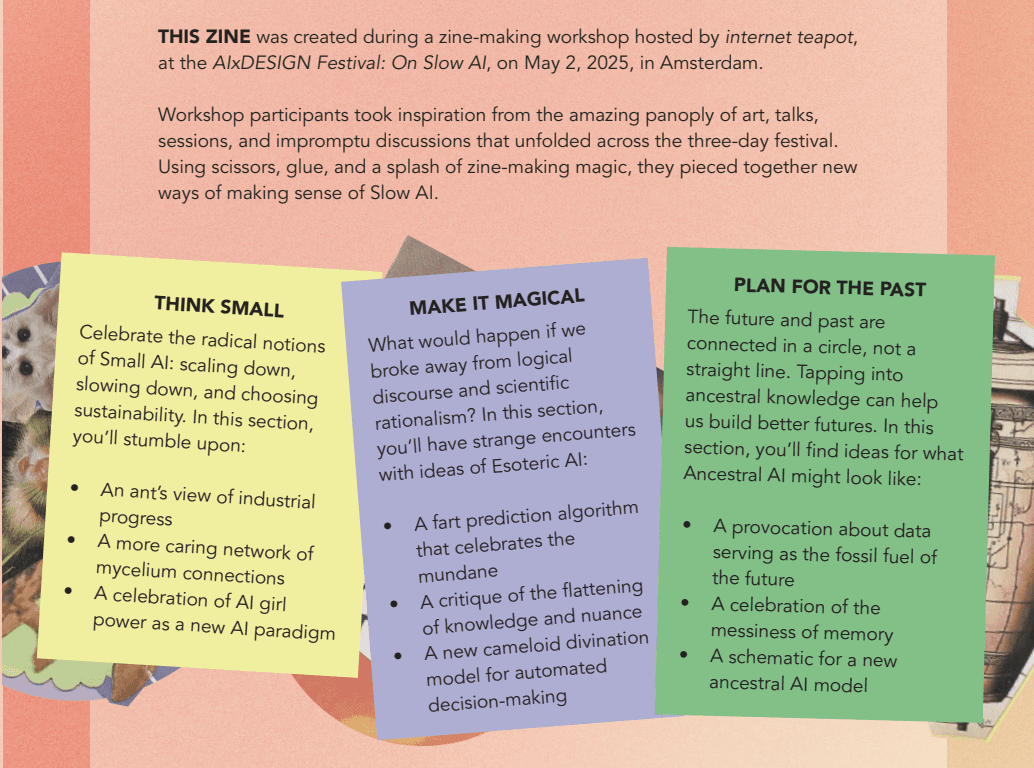
Excerpt from Making Sense of Slow AI
📌 From reports to reasoning: rethinking foresight as dialogue
An article from René Rohrbeck that expands the conversation started a few weeks ago by Amy Webb at SXSW about the coming death of trend reports (see previous digest). If you're interested in exploring the fallacies of static PDFs in enabling change, it examines the conditions under which real understanding emerges and highlights the limitations of authority or expertise compared with process and dialogue.
"What organizations need is not another report, but continuous intelligence systems: living infrastructures for sensing, sensemaking, and strategizing. Systems that bring people into the process, rather than positioning them as readers at the end of it. The 'death' of the trend report is not an endpoint. It is a transition from static knowledge to living systems. From expert conclusions to shared inquiry. From communication to deliberation."
Thanks for reading. See you next week for another wandering through ideas shaping change, innovation, and technology.